Zombie Shooter: Evil Outbreak — Scene Notes Under Pressure
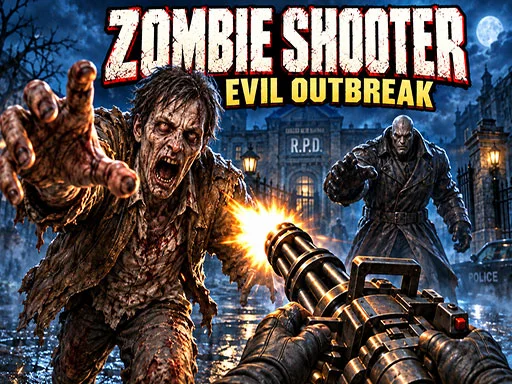
Zombie Shooter: Evil Outbreak presents an outbreak zone where a shooter, approaching zombies, cover, projectiles, and environmental hazards compete for attention. The setting suggests urgency, but the scene remains most useful when threats are read through direction, distance, and the space available around the viewpoint.
Scene notes
The nearest moving silhouette
Distance changes priority. A small figure can remain important if it is moving toward the center, while a larger figure at the edge may be leaving the immediate area. Silhouette and direction often communicate more than surface detail during a crowded encounter.
Cover as a fixed reference
Walls, vehicles, barriers, or other stable objects divide the outbreak zone into readable regions. They help locate a threat after the viewpoint shifts and show where open movement is limited. Repeated landmarks restore context after an impact effect.
Aiming and impact feedback
The aiming cue identifies the selected region. Impact feedback then confirms contact or direction, but it should clear quickly enough to expose the next approach. A short, precise effect supports observation better than a large cloud that hides nearby movement.
Pressure across the screen
Several threats do not create equal pressure. Their spacing, direction, and overlap with available routes determine how the scene feels. A loose group leaves room for attention to move between figures; a dense cluster compresses decisions into one region.
The viewer benefits from alternating focus. Narrow attention is useful for aiming, while a wider scan reveals what changed elsewhere. Returning to the full scene after each visible response prevents one target from dominating too long.
Details to monitor
- Movement toward the viewpoint rather than size alone.
- Open routes between fixed objects.
- The position of threats relative to cover.
- The duration of projectile and impact effects.
- Any current cue shown by the active interface.
Atmosphere and hierarchy
An outbreak environment may use damaged architecture, dark tones, and harsh highlights. These details support the mood, but hostile figures and aiming information need stronger contrast. Background destruction should never become visually equivalent to an active threat.
Sound and animation may reinforce the tension where supported, yet the published page remains understandable through its visible elements. Device and browser conditions can affect how quickly effects and input respond.
Closing observation
The live Zombie Shooter: Evil Outbreak page shows the current encounter, while Shooting Games collects other browser titles involving visible targets.
The scene is strongest when urgency comes from changing spatial relationships rather than uncontrolled clutter. Fixed cover supplies order, moving zombies alter it, and aiming feedback connects the viewpoint with a chosen region. This notebook avoids unsupported claims about missions, weapons, waves, upgrades, or rewards.
As a complete composition, the outbreak alternates between uncertainty and confirmation. Movement signals a possible threat, aim narrows the field, an effect confirms the response, and the wider scan begins again. That repeated sequence gives the dark environment a readable rhythm.
Depth across the outbreak zone
Foreground, middle distance, and background should not compete equally. Nearby hazards need sharper contrast and larger silhouettes, while distant architecture can be quieter. This separation helps the viewer judge which movement requires immediate attention and which belongs to the developing scene.
Overlapping figures can temporarily flatten that depth. Differences in motion, outline, or lighting restore individual positions without requiring a label over every object. The result is a layered encounter in which distance remains visible even when several threats share the same direction.
When the camera moves, fixed landmarks reconnect those layers. A doorway, barrier, or vehicle can show where a distant figure stands relative to the viewpoint and prevent rapid action from erasing the geography of the encounter.