VOLLEY CLASH: Scene Notes Across the Net
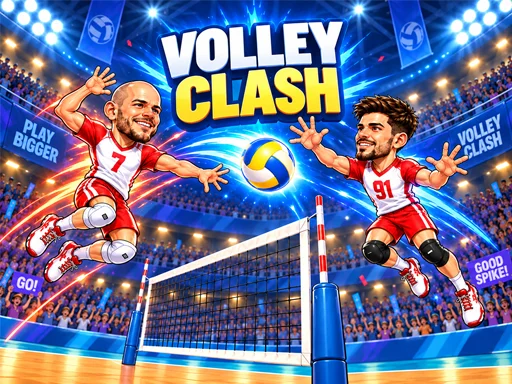
VOLLEY CLASH arranges its sports scene around a court, two sides, a central net, moving players, a ball, and visible score or timing information. The composition is immediately divided, giving every contact a direction and every return a destination.
Scene notes
The net as the central boundary
The net separates opponents while connecting their actions. The ball repeatedly crosses this boundary, turning it into the most stable reference on the court. Height relative to the net helps show whether the current trajectory remains playable.
The ball as a moving focal point
Players and court lines remain visible, but the ball carries the immediate action. Contrast and a clean silhouette help it survive against changing backgrounds. Its arc communicates timing before any score indicator confirms the result.
Players and preparation
A player’s position before contact is as informative as the strike itself. Spacing from the net and relationship to the expected landing region show how the next exchange is being prepared. Movement gives the court a rhythm of anticipation, contact, and recovery.
A court built for comparison
The two-sided layout makes distance easy to judge. Court lines frame legal space, while the net provides a vertical measure. The viewer can compare player positions across the same geometry without needing a constantly changing camera.
Score information belongs outside the central rally but remains close enough to provide context. It records the result of an exchange; it should not compete with the ball while the rally is active.
Details to observe
- The ball’s height relative to the net.
- The open region on the opposite side.
- Player position before and after contact.
- The difference between rally feedback and score feedback.
- Any timing cue presented by the active interface.
The rhythm of a rally
A readable rally forms a visual sentence: approach, contact, flight, response. Each phase occupies a different part of the court but remains connected by the ball. The strongest presentation gives the viewer enough time to locate the next phase without slowing the exchange.
Animation can add force to a hit, yet the outgoing direction must remain visible. Brief effects work best when they emphasize the moment of contact and then clear the view for the ball’s path.
A measured conclusion
VOLLEY CLASH gains clarity from familiar sports geometry. The court establishes order, the net gives movement a boundary, and the ball translates individual actions into a shared rally. Energy comes from timing and direction rather than visual clutter.
View the complete scene on the VOLLEY CLASH page, or continue through Sports Games for other browser competitions.
This notebook does not invent teams, tournaments, rewards, or control schemes. It concentrates on the confirmed visual structure and treats the live interface as the final source for current play information.
Notes on depth and timing
The ball may move toward or away from the camera as well as across the net. Changes in apparent size, height, and overlap with court lines help communicate that depth. When these cues agree, the trajectory feels coherent even during a fast exchange.
Timing feedback should arrive close to the contact it describes. A delayed effect can make one hit appear connected to the following movement, while an oversized effect can hide the opening phase of the return. Restraint keeps cause and result paired.
Closing scene
At its clearest, the court never stops being a map. Each side has an identifiable area, the net remains the central divider, and the ball briefly redraws the relationship between them. The scene can feel energetic while its basic geometry stays calm and dependable.