RequiemNoire: Scene Notes on Time, Direction, and Shadow
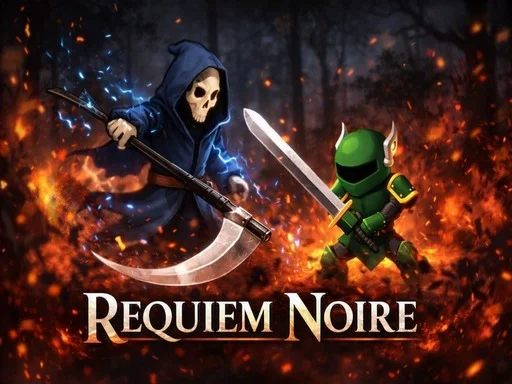
RequiemNoire presents a dark reflex challenge centered on directional prompts, a diminishing timer, and the threat of an approaching blade. Its scene is restrained, allowing the important signals to remain visible while the atmosphere supplies pressure.
Scene notes
The directional prompt
The requested arrow is the most immediate piece of information. It converts the scene into a precise visual question with a short response window. Because accuracy matters alongside speed, recognizing the symbol clearly is more useful than reacting before its direction has been understood.
The timer as visible tension
The timer gives the scene a measurable pulse. It shows how long the current response remains available and makes hesitation visible. A correct input restores time, so the display connects each decision to the survival rhythm without needing a complicated interface.
The blade and the surrounding darkness
The blade represents the consequence of delay or error. Dark tones reduce competing detail and keep the threat, timer, and prompts in the foreground. This contrast creates atmosphere through composition rather than through exaggerated effects.
A pattern of concentration
The interaction can be read as a repeating sequence: identify the arrow, respond accurately, confirm the updated timer, and prepare for the next prompt. Trying to anticipate an unseen direction would add uncertainty. The displayed cue is the reliable source of information, and attention should return to it after every response.
Short pauses between prompts are useful moments to reset visual focus. The challenge becomes less about frantic motion and more about maintaining a consistent chain of correct observations. The clean layout supports that discipline by giving each signal a distinct purpose.
Details to watch
- The orientation of the current arrow.
- The amount of time remaining.
- The feedback following a correct or incorrect response.
- The blade’s position as the scene develops.
- Any change in pacing communicated by the screen.
A restrained conclusion
RequiemNoire uses a small set of visual elements to create a coherent reflex test. Direction supplies the question, time defines the limit, and shadow gives the encounter its character. The result is most effective when the player maintains accuracy instead of allowing the atmosphere to dictate hurried input.
Read the scene directly in RequiemNoire, or continue through the Hypercasual Games collection for other compact browser experiences.
Rhythm without visual excess
The scene’s restraint is important because the task depends on rapid recognition. Additional decoration could weaken the distinction between one directional cue and the next. By keeping the active symbols prominent, the design allows atmosphere and function to support each other. Darkness sets the tone, while bright or sharply defined information remains available for action.
Consistency is the final compositional strength. Each response returns attention to the same limited group of elements, so the player does not need to search a new region of the screen after every input. The pressure changes through time and consequence, not through an unnecessarily shifting interface.
Audio, when enabled by the game and browser, can reinforce this rhythm, but visual cues remain essential. A player should still be able to identify the requested direction and observe the timer directly. Keeping the decisive information on screen supports a more dependable response than relying on atmosphere alone.
The title’s compact format makes small variations in pace especially noticeable. As the sequence continues, concentration becomes a resource in its own right. Returning the eyes to a consistent focal point after every input limits distraction and gives the next symbol the clearest possible context.