Gun Thief Auto: Notes From a Voxel City at Golden Hour
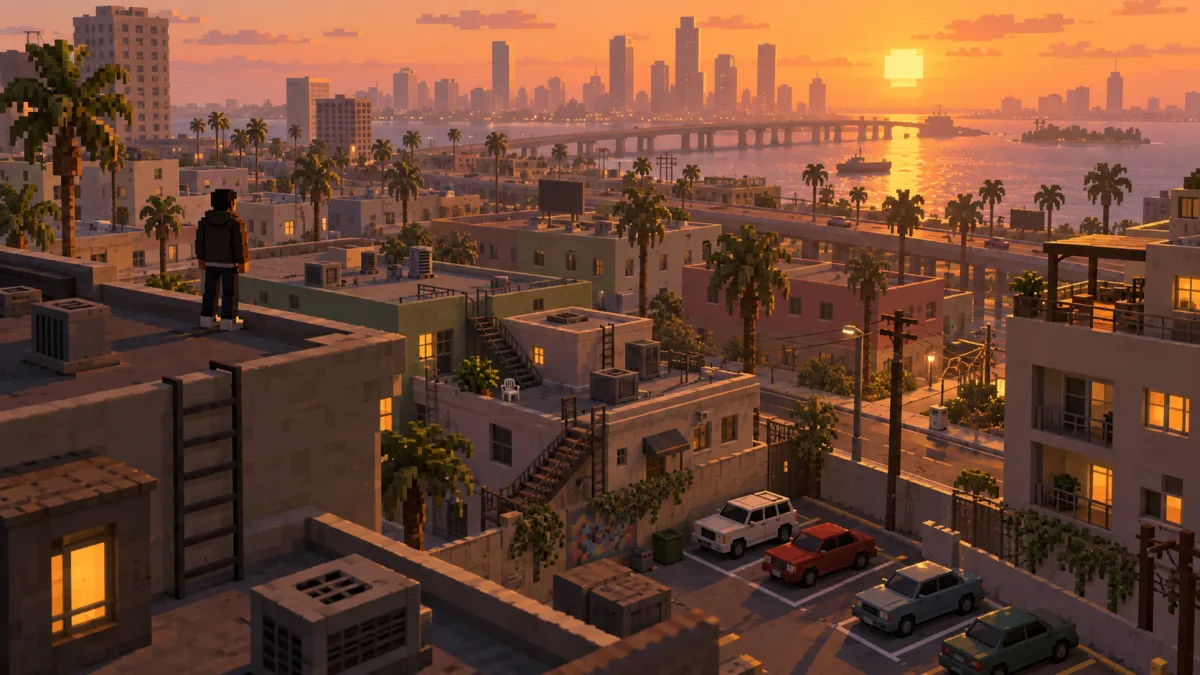
Gun Thief Auto is recorded here as a quiet voxel city at golden hour. An anonymous figure stands on a rooftop while parked cars, stairways, bridges, palm trees, and layered blocks extend toward the water. The known open-world urban theme informs the scene, but the notebook deliberately avoids depicting a mission, active pursuit, weapon, named character, or exact district.
Scene Notes
Height Changes the Meaning of the City
From street level, buildings behave like walls. From the roof, they become a connected field of ledges, stairs, alleys, and courtyards. The elevated viewpoint reflects the confirmed presence of accessible rooftops while remaining an editorial interpretation rather than a route map.
Parked Cars Create a Local Scale
Four vehicles occupy a small lot below. Their repeated length makes the surrounding buildings easier to measure. Different colors separate them without implying specific vehicle classes, speed, ownership, or availability.
Sunset Organizes the Materials
Warm light catches roof edges, windows, water, and the long bridge. Concrete stays comparatively matte, glass holds smaller highlights, and shadowed streets become cooler. Those material differences prevent the block-based architecture from appearing flat.
Reflection
The distant skyline looks active, but the foreground remains still. This contrast allows the city to feel broad without filling every roof and road with movement. The lone figure supplies a human reference and a point of attention, yet no story is assigned to that person.
Details Entered in the Notebook
- Rooftops form a second layer above the street grid.
- Stairs and ladders repeat vertical movement.
- Vehicles remain parked and no chase is shown.
- The bridge ties the local district to the distant skyline.
- No logo, copied interface, readable text, or active violence appears.
Why Restraint Helps
An action theme does not require every image to show conflict. Here, anticipation comes from observation: several possible routes are visible, evening is approaching, and the city continues beyond the frame. That ambiguity respects the available facts and gives architecture room to carry the article.
Final Entry
Visit Gun Thief Auto, continue to Adventure Games, or return to the Gamess homepage. The scene is best understood as a study of height, distance, and urban rhythm—not as evidence of an undocumented event.
The Waterfront Opens the Grid
Water and sky interrupt the dense pattern of buildings. Their broad reflective surfaces create a pause after the repeated rooftops, then guide attention toward the skyline. The bridge crosses that pause and reconnects the near neighborhood with the distant city.
Repeated Squares Do Not Need to Feel Repetitive
Windows, roof units, parking spaces, and voxel foliage share block-like construction, yet their spacing varies. Tight clusters appear around buildings, open rectangles define roads and lots, and scattered lights mark inhabited areas. Variety comes from arrangement rather than from abandoning the visual style.
Notebook Margin
This image records a city waiting for action rather than action itself. That distinction is useful: it acknowledges the open-world setting while avoiding unsupported events. Routes, vehicles, height, and distance are visible facts inside the artwork; motives and outcomes remain intentionally unwritten.